

When people talk about executive presence, they usually reach for words like confidence, communication, or gravitas.
Those things matter.
But in my experience coaching leaders, including many who are already excellent at this, executive presence isn't fully tested in ordinary meetings. It's tested in the moment everyone will replay afterward:
- When the room is waiting for someone to speak.
- When emotions begin to rise.
- When the board asks the question no one prepped you for.
- When the client is disappointed and looking at you specifically.
- When the team has run out of its own answers.
- When everyone in the room knows this conversation will be remembered.
You've already built the fundamentals. You don't rush. You don't avoid hard things. You don't need this letter to tell you to breathe before you speak.
So this isn't a reminder of the basics. It's about what separates strong leaders from the ones people would follow into anything…the extra half-step that only shows up when the stakes are real and everyone in the room is counting on you personally.

Executive Presence Isn't One More Competency
We've spent months exploring the capabilities that shape effective leadership - strategic thinking, judgment, decision making, communication, emotional intelligence.
It would be easy to think of executive presence as one more item on that list.
It isn't.
Picture a whiteboard with Executive Presence written in the center, and arrows feeding in from every capability you've already built. Executive presence is what happens when all of them fire at once, under conditions designed to make that hard.
Here's the part that matters most for a leader at your level: high-stakes moments don't just reveal presence. They tax it. The pressure that would rattle a less experienced leader doesn't rattle you but it does draw down a reserve.
The leaders who sustain presence across a genuinely hard stretch - a board fighting them on strategy, a crisis with no good options, a room that has stopped trusting the plan - aren't relying on raw composure anymore. They're relying on something they built in advance.
That's the shift this is really about: from having presence to sustaining it when the moment refuses to let up.
Presence Precedes Influence — But Trust Compounds
Think about the last time you walked into a room where the outcome truly mattered, and you were the one everyone turned to. Before anyone evaluated your recommendation, they were answering a quieter question first:
Can I trust this person…right now, with this?
You've earned that trust in normal conditions. The harder truth is that trust is re-evaluated, not just remembered, in every high-stakes moment. A track record buys you the benefit of the doubt for the first sixty seconds. What you do in the next ten minutes decides whether that trust compounds or quietly erodes.
That's the real question for a leader everyone is already counting on: not "how do I earn credibility," but "how do I spend the credibility I've already earned wisely, in a moment where I can't afford to spend it wrong."
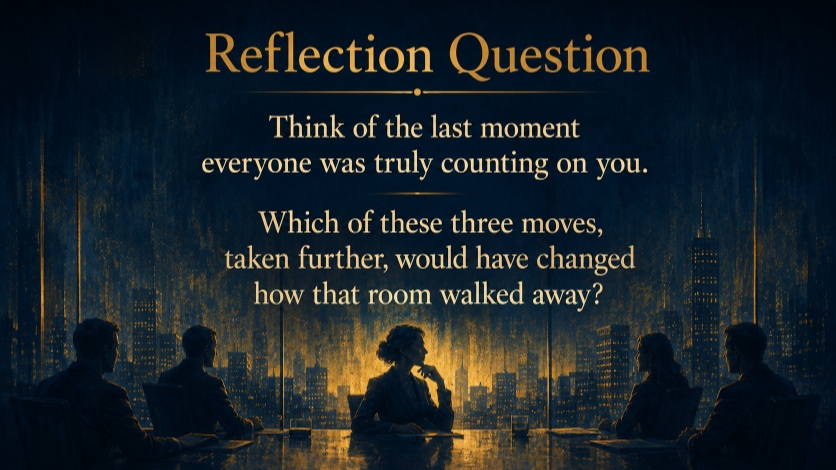
Three Moves — Taken Further

You already know Pause, Name, and Shape. At your level, the moves aren't new. What's new is how far you're willing to take them when the room is genuinely on the line.
Pause
Hold long enough to change the room, not just yourself. Most leaders learn to pause for themselves, to think before reacting. The next level is pausing for the room.
What to do: When the moment is tense enough that people are bracing for your reaction, extend the pause past your own comfort. Let it run a beat longer than feels natural. That extra beat isn't hesitation - it's a signal that you're taking the full weight of the question seriously, not just formulating a fast answer to relieve the tension.
Why it works at this level: A brief pause shows composure. A held pause reorganizes the room's expectations — it tells people the answer they're about to get was actually considered, not reflexive. That distinction is what people remember when they describe you afterward as someone who was "steady under real pressure," not just polished.
Practice it: In your next genuinely difficult conversation, pause one full beat past the point where it starts to feel uncomfortable. Notice what changes in the room while you hold it.
Name
Say the thing no one else has the standing to say. You already name the unspoken issue in ordinary meetings. The higher-stakes version isn't naming the obvious tension. It's naming the thing that only you, specifically, are positioned to say without it sounding like an accusation or a retreat.
What to do: In the moment everyone is counting on you, ask yourself: what's true here that only I can say without it costing someone else something? That might be owning a decision publicly before anyone assigns blame. It might be naming that the plan isn't working, before the room forces you to. Say it plainly: "I want to name something before we go further, and I want to be the one who says it."
Why it works at this level: Anyone can point out a problem. Fewer people can name a hard truth in a way that lowers the temperature in the room instead of raising it. That's the difference between naming as an observation and naming as leadership — and it's the version people are hoping you'll deliver when they're counting on you specifically.
Practice it: Before your next high-stakes conversation, identify the one true thing that's yours to say…not the team's, not the situation's, yours. Practice saying it in a single sentence that carries no blame.
Shape
Carry the room when it can't carry itself. You already shape rooms well in normal conditions, a good question here, a redirect there. The extra capability shows up when the room has lost its own center: when people are talking past each other, when fear has replaced clear thinking, when no one else is going to step in.
What to do: Recognize the moment the room stops being able to shape itself. That's your cue to do more than nudge — to explicitly hold the frame: "Here's what we're actually deciding right now," or "Let's come back to what we're solving for." This is heavier-handed than your usual light touch, and that's the point — it's calibrated to a room that needs it.
Why it works at this level: Restraint is usually the right instinct. But leaders everyone is counting on need to recognize the rare moment when restraint becomes abdication, when the room needs someone to hold it together out loud, not just steer it quietly. Knowing the difference, and being willing to act on it, is what separates strong presence from presence that's available exactly when it matters most.
Practice it: In your next difficult meeting, watch for the moment the room loses its own thread. When it happens, don't wait for someone else to catch it. Name what's being decided, out loud, in one sentence.
Gravitas Is Steadiness Under Load, Not Just Steadiness
Gravitas isn't about appearing important, speaking the most, or projecting certainty you don't have. You know that already.
The version worth building next is gravitas that holds up under sustained pressure, not just the first five minutes of a hard conversation, but the fortieth. Anyone composed can look steady for one difficult exchange. What's rarer, and what people are truly counting on from you, is steadiness that doesn't degrade as the stakes stay high longer than anyone expected.
That kind of gravitas isn't performed in the moment. It's built beforehand, in how you recover between hard conversations, in what you do the night before the board meeting, in whether you've actually rested enough to have something left to give when the room needs it from you for the third hour in a row.

The Measure of Executive Presence, Raised
The usual question is: "What becomes possible because I was in the room?" At your level, ask a sharper version: What becomes possible because I was still fully present after the room had already asked everything of me?
Did people still think clearly in hour three? Did the quality of your listening hold up after the fourth hard question? Did the team leave more confident than when they arrived, not because the news was good, but because you were still steady when it wasn't?
That's the version of executive presence that's actually scarce. Not presence when it's easy to hold. Presence that's still available when everyone in the room is counting on you and the moment has already taken everything you had to give once.
Your Practice This Month
You don't need to master all three moves. You already have real command of them.
This month, pick the one edge that will matter most the next time the stakes are real:
- If you tend to answer fast even now, extend the Pause.
- If you tend to name the easy truth, practice naming the harder one - the Name that's yours alone to say.
- If you tend to shape quietly, notice the rare moment that calls for Shape to be louder and more direct.
Try the extended version in one meeting this week, ideally one with real stakes, not a rehearsal.
I believe in you,

Join the Conversation
Let’s continue this discussion on LinkedIn. I’d love to hear your insights, experiences, and successes (or stumbles) as you strengthen your Emotional Intelligence.
Please Spread the Word
We’d love for you to refer Tuesday’s to other leaders in your network. Please share this post and encourage your colleagues to subscribe.
Here’s to a month of clear, impactful communication together!