

One of the biggest challenges my clients bring into coaching is making the shift from producing results today, the very thing that often earned them the promotion, to thinking more strategically about the impact of what they say yes to and what they say no to.
High-performing leaders are usually rewarded for execution. They solve problems. They move quickly. They remove obstacles. They make things happen.
And then, often with very little warning, the role changes.
Suddenly the expectation is not simply to deliver results but to create the conditions for future results.
Everyone likes to think of themselves as a strategic thinker. Yet strategic thinking is less about having brilliant ideas and more about developing the discipline to pause before acting and consider the broader impact of our choices.

Strategy Happens Occasionally. Strategic Thinking Happens Daily.
Before we go further, it helps to separate two ideas that are often treated as if they are the same.
Strategic thinking and creating strategy are related, but they are not identical.
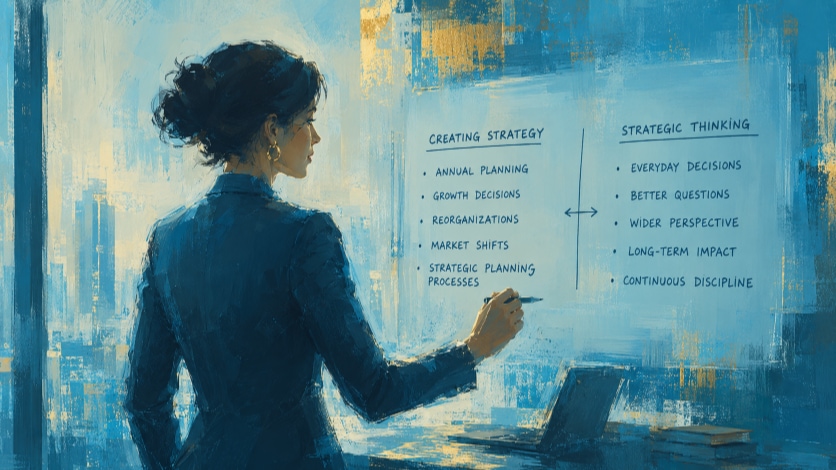
Creating strategy is episodic. It appears during annual planning, growth decisions, reorganizations, market shifts, or formal strategic planning processes. Those moments matter and require leaders to step back, make tradeoffs, and define direction.
Strategic thinking is different.
Strategic thinking is not an event. It is a way of approaching decisions every day.
It is the discipline of asking better questions before acting.
The Discipline of Asking Better Questions
Strategic thinkers learn to pause long enough to ask questions like:
- If I say yes to this, what becomes harder later?
- If I solve this myself, what capability am I preventing my team from developing?
- If we prioritize this initiative, what are we choosing not to do?
- Who else will feel the effects of this decision?
- What future am I quietly creating?
Strategic thinkers practice these questions in ordinary moments.
They do not wait for the annual retreat to think about priorities, stakeholder impact, team capability, succession, culture, or long-term outcomes. They train themselves to widen the frame and think beyond immediate wins.
Strategic Thinking Is Built Before It Is Needed…And that Matters
Because when leaders are eventually invited into the bigger moments, the growth strategy, the reorganization, the operating model redesign, the three-year plan, the leaders who stand out are rarely the ones with the most dramatic ideas.
They are the leaders who have developed the muscle.
They have trained themselves to connect decisions across the system, anticipate consequences, ask strategic questions, and think beyond themselves.
Executive presence is revealed in what you notice, how you decide, and what you make possible.
Executive Presence Is Built in the Ordinary Moments
People experience strategic leaders differently. They feel clearer. Less reactive. More confident in the direction ahead. Strategic leaders hold both today and tomorrow at the same time.
As you look back on this week, consider:
- Where did I stop to think beyond the immediate issue?
- Which decision created capacity, not just completion?
- How did my choices help my team, my peers, and my leader succeed?
- What future am I creating through the decisions I make today?
Strategic planning may happen once a year.
Strategic thinking happens every day.
And executive presence is often built the same way, not in the big moments everyone sees, but in the ordinary decisions that quietly shape trust, direction, and possibility.
Think beyond the task. Lead beyond the moment.
I believe in you,

Join the Conversation
Let’s continue this discussion on LinkedIn. I’d love to hear your insights, experiences, and successes (or stumbles) as you strengthen your Emotional Intelligence.
Please Spread the Word
We’d love for you to refer Tuesday’s to other leaders in your network. Please share this post and encourage your colleagues to subscribe.
Here’s to a month of clear, impactful communication together!